During the coronavirus disease 2019 (COVID-19) pandemic, BlacklivesMentored has responded to individuals referred to our service. Most recently, we received a referral to provide mentoring support to a 44-year-old black female residing in the UK having a Zimbabwean heritage; for confidentiality reasons I will refer to her as client A.
To measure the effectiveness and success of the service we provide, you can see from our evaluation when working with A. Firstly, we carried out an assessment with A and she met our criteria to access the mentoring service. A is a resident of Derby city, she had been diagnosed with having a severe case of Covid 19. She was admitted to the Intensive Care Unit at the Royal Derby hospital and placed on a ventilator machine; A was later placed in an induced coma while she was being treated. A, spent several weeks in hospital and was discharged from hospital to her parent’s home to convalesce, with a supply of oxygen. Fortunately, A recovered but temporary lost her ability to meet her own personal care needs or mobilise independently, she experienced some communication problems and brain fog but what was most disturbing was the loss of her identity as a mother and the second daughter for her parents. A was left feeling low in mood and depressed. Following a referral and being accepted to the charity, a mentor was allocated to A. The mentor would call A once a week on a Tuesday at 10 AM for an hour mentoring session. At the beginning of the first session the mentor completed the Individual Support Plan with A, and she scored the following:
- Learning social or domestic needs 2 out of a possible 8
- Self-care needs 2 out of a possible 8
- Social and community networks 4 out of a possible 8
- Self-esteem and self-confidence 3 out of a possible 8
After three-weeks of working with client A, her scores were reviewed, an improvement of her condition was evidenced in her soring as documented below:
- Learning social or domestic needs 3 out of 8
- Self-care needs 2 out of 8
- Social and community networks 5 out of 8
- Self-esteem and self-confidence 4 out of 8
Finally, at the end of our six-week involvement with client A, her scores were again reviewed, and the findings evidenced a further improvement of her condition as stated below:
- Learning social or domestic needs 6 out of 8
- Self-care needs 6 out of 8
- Social and community networks 7 out of 8
- Self-esteem and self-confidence 7 out of 8

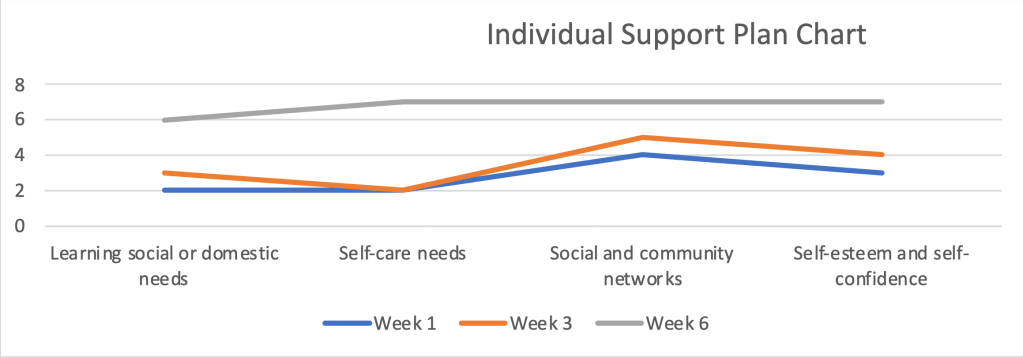
system of evaluation has enabled us to monitor a client’s experience and to make changes throughout the programme if necessary to meet assessed needs. If a client at assessment score with a low number and at the end of their six weeks of mentoring sessions this number has increased considerably then we will know that our service is making a difference to their lives.
In the case of client A, her scores throughout our involvement shows a steady progression of improvement to her health and well-being, this we believe was in part attributed to her accessing the service. In addition, the scores from our evaluation system continues to inspire us at the charity to develop the service further in the hope of supporting other BME individuals by offering this unique professional, cultural, person centred mentoring service.
On receiving our support, client A is now able to independently respond to her social, self-care and domestic needs. She is accessing the community with reduced support and her self-esteem and self-confidence has grown which has enabled her to re-engage with her family, her identity and has now returned home.
 Blacklivesmentored